To assist researchers in filling out the Human Subjects & Clinical Trials (HSCT) form, NIH required fields are now indicated with an asterisk and red highlighting. These same fields will have validation messages when the user clicks “Show Form Errors” at the top of the form. All NIH errors and validations will continue to show when the full application is checked by clicking “Check for Errors” in the left navigation of SAGE.
eGC1 Data Sync Improvements with Grant Runner Forms
To help prevent data inconsistencies when multiple browser sessions are open, the data sync between the eGC1 and Grant Runner forms has been improved. When you make updates to information in the eGC1 that flows through to Grant Runner forms, those updates will now automatically sync with each save/refresh of the eGC1.
Improved Accessibility for Keyboard and Tab Order Functionality
To meet accessibility standards, all Grant Runner forms are now accessible using keyboard only functionality. In addition, tab order has been improved to be more logical and intuitive, reducing the number of times the user has to press the tab key.
Error Messages Enhanced
Question numbers have been added to error messages on all Grant Runner forms. This update will help users quickly identify the specific error within a form. This will be especially helpful for longer forms such as the new Human Subjects & Clinical Trials form.
On the Non-Fiscal Compliance page, in the Data & Technology section, if you answer Yes to questions D-2 and/or D-4, the system will automatically add a hold for Export Control. The hold will be added when the eGC1 reaches In OSP status.
Funding Actions
When OSP creates a child Funding Action (FA) for an awarded eGC1, the system will automatically create compliance holds, if appropriate.
The system applies automatic holds to the FA based on the conditions in the following chart.
Details page has an Originating Sponsor listed with a Sponsor Type of Federal Government
SFI/FCOI
One or more investigators on the PI, Personnel, & Organizations page has an SFI value of Yes or Unknown
Export Control
Non-Fiscal Compliance page: if Yes for any one of questions E-2, D-1, D-2, D-3, D-4.
IACUC
Non-Fiscal Compliance page: question AU-1 = Yes
FCOI Training
One or more investigators on the PI, Personnel, & Organizations page has either not done the sponsor-required FCOI training or the training has expired.
NIH will require the use of FORMS-E application packages for due dates on or after January 25, 2018. Grant Runner now includes the FORMS-E version for the following agency specific forms.
PHS 398 Cover Page Supplement
PHS 398 Research Plan
PHS 398 Career Development Award Supplemental
PHS 398 Modular Budget (expire date change only)
PHS Assignment Request
PHS Human Subjects and Clinical Trials Information (New!!)
Federal-wide form updates that will also be incorporated into FORMS-E packages, and which are supported by Grant Runner, include:
New Human Subjects and Clinical Trials Information Form
Grant Runner now includes the new PHS Human Subjects and Clinical Trials Information Form. You will have the option of completing the form in its entirety directly in Grant Runner, or importing a completed PDF version of the form into Grant Runner. Due to the length of this form, it is recommended that you preview the form in Grant Runner or in PDF format, early in the proposal development process to plan appropriately for the information collection involved.
SAGE Subawards
Subrecipient Re-Certification Status and Form
When completing the subaward request in SAGE, a prompt will display below the subrecipient’s name if their certification status is in an expired state and needs re-certification. This prompt will have a link to the Subrecipient Certification PDF form that can be uploaded in the Attachments section of the Subaward Request once completed. Attachment of the Subrecipient Certification form is not required prior to submission of the subaward request. This status prompt and link will also display in the Subaward Overview Summary section.
SAGE eGC1
Non-Award Agreement Application Types
SAGE now provides a dedicated, streamlined eGC1 format for submitting Non-Award Agreements to OSP by requiring only the set of fields necessary for these application types. You will now select Application Types “Non-Award Agreement (new)” or “Non-Award Agreement (continuation)” for the following types of agreement:
Confidentiality Agreement
Data Use Agreement
Memorandum of Understanding
Unfunded Collaborative Agreement
Unfunded Research Agreement
Affiliation Agreement
Material Transfer Agreement
Note that you should select “Non-Award Agreement (continuation)” to extend an existing agreement beyond the initial term.
Activity Locations Survey
We want your feedback on the new look and feel of the Activity Locations page. Click the “Give Feedback” link at the top of that page and let us know what you do/don’t like about the design as we evaluate updates to other parts of SAGE.
This form is required for all NIH applications using Grant Runner.
Select PHS Human Subjects & Clinical Trials from the left navigation menu to open the form. The form consists of several sections:
Human Subjects Section with responses from R&R Other Project Info Form
Human Specimens section
If Yes to Human Subjects section, conditionally displays
Add Studies
Other Requested Info
Responses from R&R Other Project Info Form
This section displays the answers to the Other Project Info form’s Human Subjects questions.
Use of Human Specimens and/or Data
In this section, you must indicate if your research will involve human specimens or data.
If you answer “Yes” then a link to add an attachment will display. Attach a PDF formatted file explaining any use of human specimens and/or data not considered to be human subjects research. See your funding opportunity announcement and agency-specific instructions for additional guidance.
If Yes to Human Subjects
If you answered “Yes” to Are Human Subjects Involved on the Other Project Info form, this section will display.
Add Studies
Add a record for each proposed Human Subject study by selecting Add New Full Study or Add New Delayed Onset Study. There is also an option to import a study. For specific details on the steps involved, please see the Adding HSCT Studies article.
Other Requested Info
Attach any other relevant documents as requested by the sponsor. The attachment should be a PDF formatted file. See your funding opportunity announcement and agency-specific instructions for additional guidance.
Select an answer for the question “Will this project involve any new construction or renovation of existing facilities?”
If you select “Yes” additional fields display. You must complete the “Who provided approval?” field.
The optional fields are:
Approval date
Where is the space
Additional Explanation
The following image shows the question answered Yes and the fields displayed.
Use the “Back to Activity Locations Summary” link at the bottom of the page to return to the main Activity Locations page. The section will now a link to “Edit Section” if needed, and a Expand + link. Expand displays the data entered, and switches to Collapse when used. The following image shows the section expanded with some sample data.
Activity Locations captures information to assist eGC1 preparers & reviewers in determining correct F&A rates and documents resource planning for campus units
Space Planning helps campus reviewers determine if there are special fees, permits, or approvals required for renovations or construction activities
International Involvement assists in identifying projects that may need targeted support for international activities
The following image shows the Activity Locations summary page before any sections have been started.
Select “Start Section” to open a section for data entry.
The following articles cover each section in detail.
Use this section to identify each location where UW research activities are taking place. You must enter at least one location. As with other eGC1 pages, you can partially complete your entries and save the eGC1. You must complete the required fields before you route your eGC1 for approval.
List performance sites where UW personnel will work on the project. Do not list:
Authorized official (OSP)/institutional mailing address
Subrecipient locations
Other locations where UW personnel will not be working
Field work occurring away from the UW for less than 30 consecutive days (unless required by your Dean’s Office)
See GIM 13 Facilities and Administrative (F&A) Rates for additional information on determining Activity Locations.
If some UW activity locations are “to be determined” at proposal time (for example, a Training Grant for which trainees and their projects are “to be named”), please enter all known UW Activity Locations (Harborview Medical Center, UW Health Sciences Building, and so forth).
SAGE integrates with UW’s space tracking system GeoSIMS, allowing you to search for a location by facility name, address or facility code. You can also manually enter locations not found in GeoSIMS by selecting Create a New Location.
The image below shows the section opened to add a location. Select + Add Location to open the dialog where you can search GeoSIMS location data or add a new location.
Add a Location
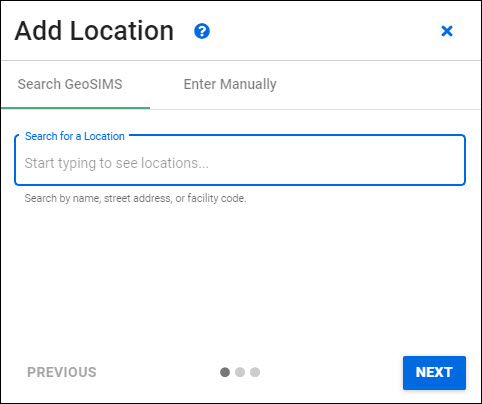
When you select Add Location a dialog will open. You can either search GeoSIMS for a location or add one manually. By default the search choice will display. The following image shows the dialog.
Search GeoSIMS
Start entering text to see search results. You can search by name, street address, or facility code. If there is no match, use the Enter Manually feature to enter your location, as described below.
Clicking on your selection from the results list will display the name and address of the location. The following image shows the information for Mary Gates Hall.
Select the blue “Next” button in the lower right corner to continue to the next step. This asks the question: How will the location be made available to the program? The choices are:
Leased by the UW
Owned by the UW
In a facility offered at no cost to the UW
Field work away from the UW for more than 30 consecutive days
Other
The system will prepopulate the value for this location from GeoSIMS. The image below shows the modal with the “Owned by the UW” choice selected.
Use the small, blue X in the upper right corner to cancel and return to the section page. Select the blue “Next” button to the next step.
In this step you can optionally enter any additional comments or descriptions about the location.
If your location is leased, there will be an additional question in this step: Will rent be charged to sponsor as a direct cost? If you answer “No” you will need to provide an explanation. This following image shows this step.
Select the blue “Save” button in the lower right corner to complete the process.
Manually Enter a New Location
When you select Enter Manually in the initial dialog, it will display the Add Location step, where you can add the Location Name (required) and address information (optional). The address fields are:
Street Address
City
State
Zip
Country
The following image shows the input fields.
Use the small, black X in the upper right corner to cancel and return to the section page. Select the blue “Next” button in the lower right corner to continue to the next step.
You will need to answer the question “How will this location be made available to the program?” The choices are:
Leased by the UW
Owned by the UW
In a facility offered at no cost to the UW
Field work away from the UW for more than 30 consecutive days
Other
If you select either the “no-cost” option, or “other” option, the Explanation text box appears. You will need to provide additional details. This is shown is the following image.
Note: If your department/school/college requires you to list locations for field work of less than 30 days, select “Other” and put a description in the explanation box.
Select Next to continue to the last step. If your location is leased, there will be an additional question in this step: Will rent be charged to sponsor as a direct cost? If you answer “No” you will need to provide an explanation. You must also provide a short description of the location and any justifications for its use.
Added Locations Table
The Activity Locations section will display your added locations in a table below the Create a New Location link. To expand or contract a table entry, click on the “chevron” icon on the far left, or anywhere on the entry fields. An additional row of information will display.
The table includes the following columns:
Name – location name from GeoSIMS or a newly added location
Source – GeoSIMS if searched for or Manual for a new location
Location Type – Owned or Leased
Rent Charged to Sponsor – N/A for owned; either Yes or No. If No, the Rent Explanation displays below.
Actions – displays two icons: a pencil for editing the entry and a trash can for deleting the entry
Address information appears below Name when the entry is expanded
Description comments appear below Source when the entry is expanded
Rent Explanation appears below Rent Charged to Sponsor when the entry is expanded
When you return to the Activity Locations main page, this same table will appear, along with an Edit Section link.
The image below shows the addition of two locations from GeoSIMS. Both entries are expanded to display all of the information. The locations are Padelford Hall on the Seattle campus and a South Lake Union Lab off campus.
Use this section to identify the countries where research will occur. Note: this question was formerly on the Details page.
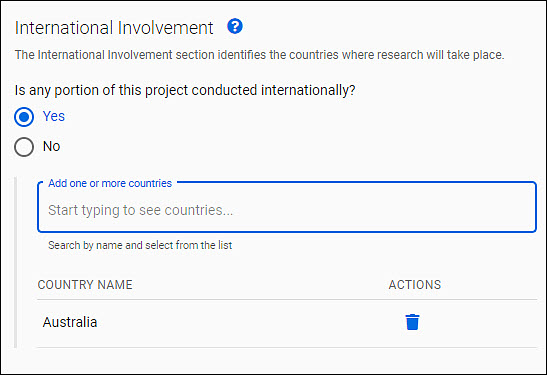
If you answer “Yes” to the question “Is any portion of this project conducted internationally?” the country search box displays. You must select at least one country. The country list is the more comprehensive international standard ISO 3166.
Once you have entered at least three characters in the search box, the system will display a list of matching countries. The match may occur at the beginning of the country name or within the name. Click on the country name to select it. Search for and select as many countries as needed.
Once a country is added to the list, a delete icon (trash can) appears in the Actions column. Selecting it will remove the country from the list.
The following image shows the question answered Yes and two countries selected.
Use the “Back to Activity Locations Summary” link at the bottom of the page to return to the main Activity Locations page. Select the Expand + link to see the data you entered in read-only view. Use the “Edit Section” link to re-open the section for editing. The following image shows the read-only view of the data.
The Common Interdisciplinary Organizational Unit Reviewers section of the PI, Personnel, & Organizations page allows you to select one or more units for your application.
The units are:
Center on Human Development and Disability (CHDD)
Alcohol and Drug Abuse Institute (ADAI)
Washington State Transportation Center (TRAC)
Radiology Services
Primate Center (only on historic applications)
Selecting a unit automatically adds their reviewers to the approval flow.
In addition, if you select ADAI, and/or Radiology Services, the School of Medicine will be added as a Watcher.
For certain types of funding applications, there is a need to list a PI (Principal Investigator) on the sponsor application forms that differs from the PI on the eGC1. This is often the case with NIH Career Development mentored opportunities and Fellowships, when the PI on the sponsor forms does not meet the eligibility requirements necessary to serve as a UW PI.
In order to better identify and accommodate this situation, a new personnel role type has been created on the “PI, Personnel and Organizations” page, called “Application PI”. When the Application PI role is selected, additional contact details for person will display and be editable. This will allow preparers to call out the contact information to be used on the sponsor forms. This is particularly important for NIH applications using Grant Runner.
This new role should only be used when there is a need to designate a different PI on the sponsor forms than on the eGC1.
“Application PI” flow to Grant Runner Forms
When an Application PI role is assigned to a personnel entry, and Grant Runner is being used to complete the sponsor forms, then the Application PI name and contact information will automatically flow through to the SF 424 and Key Person Expanded forms where the Application PI is listed.
“Application PI” and Approvals
When an Application PI is identified in the Personnel section of the eGC1, that individual will automatically be added to the approval graph, directly after the eGC1 PI. As such, they will automatically receive the same approval notification email that the eGC1 PI receives.
When the Application PI initiates their approval, they will be presented with an Assurance Statement, in the same way that the eGC1 PI is. Their approval will also represent that they have read and are providing the appropriate assurance as required by the sponsor.
“Multiple PI” Approval Changes
In order to improve efficiency and ensure compliance with federal rules around provision of assurance statements by Multiple PIs, SAGE will now automatically add personnel with the role type of Multiple PI to the approval graph. As is the case for the eGC1 PI and Application PI, the Multiple PIs will automatically receive approval notification email, and will be presented with an Assurance Statement at time of approval.
Bug Fixes: SAGE Suite
Budget: Cannot add personnel on the day they end one position and start another
You can now add personnel to a budget as they transition from one position to another.
Budget: Refresh Rate updates
Now on the Update Periods modal when you “refresh rate” for a period:
The rate will update for that period and no other periods.
If you have previously set a custom rate, the “custom” checkbox will be cleared.
Now on the F&A tab in a budget, when you “refresh rate” the “custom” check box and any justification text will be cleared for all periods and reset to the base rate.
PI & Personnel: Improved error handling on attempt to enter same person twice
When a user inadvertently attempts to add the PI to the Personnel section of the eGC1 or attempts to add one of the personnel as a PI, the system will now provide a clear message that a person can only be added to the PI, Personnel & Organizations page once.