Release date: 7/11/2017
SAGE was updated July 6th to reflect Workday salary and payroll data. This release includes a few fixes to the SAGE system.
Re-enabled Items
We’ve re-enabled the following
- Personnel Chooser: Re-enabled the ability to search for group NetIDs
- Approvals Tab: Re-enabled the Advanced Search
- Subcontract Sub Budgets: Re-enabled the ability to set custom fringe benefit rate settings for sub budgets of type Subcontract
Fixes
SAGE General Updates
Updates throughout SAGE Suite.
Data Source Updates
SAGE Suite will now use Workday data rather than HEPPS data.
Infrastructure Updates
Technology updates were made to modernize and stabilize SAGE system as areas of the software were updated.
SAGE Personnel Chooser (throughout SAGE Suite)
Search Options
Now search by EmployeeID, in addition to Name and UW NetID
Academic Appointments and Positions
When a Position and Academic Appointment are linked, they will be combined and displayed in one line
Displayed Fields
- Employee Name will display legal name
- Title will display the more useful Academic Appointment title when available. If not available, then Position title will display.
- Academic Appointment Type will display next to Title. This is new data available through Workday that provides information about the nature of the Academic Appointment. Academic Appointment Types can be Primary, Joint, Dual, or Admin. Academic Appointment Types are not applicable to Positions.
- Associated Organizational Units will display:
- Organization Name and Code display for Positions and Academic Appointments associated with a Position
- Supervisory Organization Name and Code display for Academic Appointments not related to a Position
- An indicator of a person’s Primary Position now displays next to the unit where the Primary Position resides. Primary Position replaces the former “home department” concept when determining necessary approvals.
SAGE eGC1 PI, Personnel, & Organizations Page Updates
Additional Organizational Reviewers Moved to Renamed PI, Personnel & Organizations Page
The former FG-9 Compliance page question for identifying additional organizational reviewers has been moved to the PI, Personnel & Organizations page, to align it with the personnel entries that are also feeding the approval graph. While selecting personnel, if joint appointment units need to be identified, you can now do so from the same page.
View Approval Graph link added to PI, Personnel & Organizations Page
The View Approval Graph link will now show in two places on the eGC1 — on the Certify and Route page (as always) and now also on the PI, Personnel & Organizations page. While you are changing personnel and adding additional organizational reviewers, this newly added link will allow you to quickly view the impact of your changes on the approval graph.
Primary Position Organization Code Added to Personnel Summary List
Once a person and their corresponding position have been added to the list of personnel, you will now see the organizational units for both the selected position and primary position for the chosen person. This will be a reminder that the primary position’s organizational unit will appear on the graph as well as the selected position.
SAGE Compliance Page Update
The additional organizational unit reviewers question (FG-9) has been relocated to the bottom of the PI, Personnel, & Organizations page (see above for more details).
SAGE Approvals Updates
Approval Graph Generation
- Primary Position Unit will now be used for adding Reviewers/Watchers to the Approval Graph, as the unit associated with the Primary Position replaces the concept of “home department”.
- Selected Unit will continue to be used for adding Reviewers/Watchers to the Approval Graph, but the unit will be derived as follows:
- If the selected line is for a Position, then SAGE will use the Position’s Organization Code
- If the selected line is for an Academic Appointment linked to a Position, then SAGE will use the linked Position’s Organization Code
- If the selected line is an Academic Appointment not linked to any Position, then SAGE will use the Supervisory Organization Code associated with the Academic Appointment
SAGE Budget Updates
Restructured to accommodate Workday data integration.
Object Codes
Object Codes
Are less granular in Workday with only one digit of sub-object code. They are associated with Job Profile and linked to Position rather than Distribution. Impacted Object codes are 01 Salaries and wages, 07 Employee benefits, and 08 Scholarships and awards.
- All ‘01-1X’ → ‘01-10’; ’01-2X’ → ’01-20’; etc.
- ’07-06’ → ’07-00’
- ’08-02’ → ’08-00’
Historical sub-object codes are still available for manual selection – if desired; user can select the old/more descriptive title description.
Multiple Object Code Types
The extra modal for Multiple Object Code types has been eliminated. The system defaults the object code to the one associated with the person’s Primary Position.
Benefit Rate & Costs
Default Benefit Exemptions
SAGE will now derive insurance and retirement benefit eligibility using the person’s Primary Position Object Code based on info provided by MAA as part of UW GIM 3 fringe-benefit-load-rate. This derivation of benefit exemptions works for all object codes except 01-70 (professional staff), which will default to “None” (no exemptions). For ’01-70’, there will also be an alert/message asking verify and update health and/or retirement benefit eligibility for professional staff personnel.
Earning Codes
In Workday, Earning Codes replaces the concept of Earn Types. Earning Codes are less granular and do not map exactly to historical Earn Types. Earning Codes will display on the Line Update page under Pay Type, providing additional context about salary and wages.
Institutional Base Salary (UW Monthly Salary)
Salary and wages that are considered IBS will now be pre-checked based on the updated GIM 35 definition of IBS.
RRD
Reduced responsibility cannot be uniquely identified in Workday, so the RRD personnel notification email from SAGE that’s sent post-award has been discontinued.
Non-Salary Distributions
Object Code ‘07’
SAGE does not receive any retiree Supplement data from Workday. Retirees without regular salaries but with active Academic Appointments can be added to your budget but salary and benefit information must be added manually using the [Starting Monthly Salary] field.
Object Code ‘08’
Stipends information under object code ’08’ is available as Stipends without benefits under ’08-00’ (less granular object code). Stipends under Object code ‘08’ are not considered UW Salary or IBS, and are excluded from benefit calculations.
Salary Amounts
There are 2 separate branches of distributions in Workday: planned compensation and period pays. Both are included in salary calculations for all salary fields. If current planned compensation and period pays, we will include those. If no current planned compensation or period pays are available, SAGE will utilize future dated data.
Update or Convert Salary
The SAGE Budget worksheet will now display an “H” icon next to Salary and Wages lines last updated with HEPPS data.
If you edit a HEPPS Salary and Wages line, the Line Setup modal will provide a link to “Convert” the salary, which will remove all HEPPS earning lines, and re-add the person’s latest salary lines from Workday. Prior to the removal, the system keeps a snapshot of the HEPPS earning data. The instant of the snapshot can be viewed using the History tab of a budget.
For Salary and Wages lines created or last updated with Workday data, no “H” indicator will display. The Line Setup modal will allow you to “Update” the salary (no conversion is needed).
Budget Periods
The Update Periods modal has all periods displayed on the same page for the selected line item.
With the right access, the user can update salary and benefit for each period (and thereafter). However, if the selected record is personnel from HEPPS, then the Update Salary link will not be visible. The Update Salary link only works for Workday data.
The display of Sea Pay personnel and salary info has been rearranged and shown with multiple periods. # of Hour info for each period can be entered on the same page.
Worksheet Line Setup (Non-Personnel)
The “NOTES” icon has been removed, and a note section is added to the line Item setup page. Instead of going to Period 1, 2, etc., user can access the new Line Item Update page directly by using the “Go to Iine Item Update”.
The Line Setup page includes all periods on the same page. Other than the calculated fields such as % and totals, cells for all periods can be edited together. However, the totals are not recalculated upon entry, but upon leaving. User will only be able to view the new totals after Return to Worksheet.
This pop-up window displays when you select the Check for Errors link on either the left navigation menu or the Certify & Route page. The eGC1 Final Validation section will list any errors that you need to correct before you can route your eGC1 to reviewers.
If you are creating a Grant Runner application, the Grant Runner Sponsor Forms Validation section will display below the eGC1 section.
In Grant Runner, if you choose an NIH funding opportunity that closes prior to the Sponsor Deadline on the eGC1 Details page, you will see a warning at the top of the “Check for Errors” page. This warning will not prevent you from routing the eGC1.

Note: When you select the Route to Reviewers button on the Certify & Route page, the error check is also done.
- For a standard eGC1, this window will display only if there are errors.
- For a Grant Runner eGC1, if you answered No to the Ready to Submit question, you can route your eGC1 even if there are still errors listed in the Grant Runner Sponsor Forms Validation section.
eGC1 Final Validation
If any eGC1 page has errors, you will see a heading for that page, followed by a bulleted list of errors. The information displays in the same order as the eGC1 pages.
Examples of the types of errors listed would be:
- Required fields without a value.
- “Yes” answers to compliance questions without any required additional explanations or information.
The image below shows examples of eGC1 page errors.

For a Grant Runner application, the Check for Errors process includes all of the Grant Runner mandatory forms and any selected optional forms.
The forms will be checked for any Grants.gov errors and the basic NIH errors, some of which are specific to Activity Type. Once all of those errors are cleared, your forms will be checked by an additional NIH service. It provides warnings and errors specific to your opportunity.
Note: If you select Ready to Submit = No on the Certify & Route page, you can route your application for review before all of the Grant Runner errors are fixed.
Once you select Ready to Submit = Yes, you must have fixed all errors in order to re-route your application, and for it to be submitted to Grants.gov.
Warnings will not block you from routing your eGC1 but may reveal other issues to be considered prior to submission.
The Check for Errors list identifies the form page in your Grant Runner on which the error appears, and describes the error or problem.
Example messages:
- Required or optional form not yet viewed
- Required data not completed
- Required attachments – “Biographical Sketch is required.”
- Conditionally required data or attachments – “X is required when Y condition occurs.”
The image below shows examples of Grant Runner form errors and the message about checking for NIH error once all Grants.gov errors are addressed.

General Updates
Grant Runner: Detailed and Subaward Budget Form Version Update
Grants.Gov will be releasing new versions of select forms by end of October, primarily due to some forms reaching their expiration dates. Two Grant Runner forms will be updated as a result: RR Detailed Budget and RR Subaward Budget. The RR Detailed Budget will display a new “Total Costs and Fees” calculation for each period, and for the cumulative budget. This will be visible for any opportunities utilizing version 1.4 of the RR budget form.
Updates to Human Subjects HS-1-B question
Clinical Research Budget and Billing (CRBB) has provided improved language and helpful alerts surrounding the HS-1-B compliance question. If you answer YES to HS-1, (Does this application involve the use of human subjects?), the HS-1-B compliance question appears. It will ask you about the use of UW Medicine Health System clinical services, procedures or tests in regards to human subjects use, and provides additional details intended to help you answer the question more easily.
Primate Center added to AUMS notifications
The AUMS review complete email was updated to include the Health and Safety specialist in the Primate Center on the email distribution list.
Training environment permissions updated to allow subawards testing without having the Subaward Preparer ASTRA role
The SAGE training environment has been updated to allow any user with a UW NetID to create test records in the Subawards section. Users no longer need to have the Subaward Preparer ASTRA role while working in the training environment. They will, however, still need to have the Subaward Preparer ASTRA role when working in the production (live) environment. The training environment release was made on 11/1/2016.
Fixes
Approval comments made after approval will no longer change the approval date (260583)
An issue which was causing the “My Approval Date” of an eGC1 to be updated when an approver comment was added at a later date, has been fixed. With this change, the original approval data will remain intact, when a subsequent comment is added.
Minor update to subawards return email
An update has been made to the subawards Notification of Return email, to clean up some accidental html characters displaying in the content.
General Updates
A New OAW Compliance Question for Significant Protocol Changes
A new compliance question, AC-1-D, has been added to identify grants that will require a Significant Change at the time of submission. An answer is required if the Animal Use question AC-1 is answered “Yes”.
A few textual enhancements (for existing compliance questions) were made to allow OAW to process the grants more efficiently, and they include:
- Removing the facility name and location of the work to be done on the AC-1-A for UW work
- Requesting the 3-year approval date range
- Updating electronic document submission contact info.
Sub-Object Codes 05-47 and 05-48 Added to Sage Budget for Grandfathered Awards
Effective July 1, 2016, UW’s equipment capitalization threshold will increase from $2,000 to $5,000. This change applies to all competing proposals submitted to sponsors on or after May 1, 2016. The following changes were made in Sage Budget to accommodate this threshold change:
- Two new object codes will be added to (05) Supplies and Materials to allow grandfathered awards to continue to use the old threshold for non-capitalized equipment:
- 05-47 Non-Capitalized Equipment ($2,000-$4,999) – Grandfathered Awards
- 05-48 Non-Capitalized Equipment – M&E Tax Exempt ($2,000-$4,999) – Grandfathered Awards
- These two new object codes will be excluded from F&A calculation when using the following cost bases for budgets associated with grandfathered awards:
- Exclude 05-47 and 05-48 form Total Direct Costs less Equipment & Tuition (TDC less E&T)
- Exclude 05-47 and 05-48 from Modified Total Direct Costs (MTDC)
- The following object code descriptions will be updated as listed below to reflect the new threshold of $5,000:
- 05-40 Non-Capitalized Equipment (less than $5,000)
- 05-41 Non Capitalized Equipment –M&E Tax Exempt ($200 – $4,999)
- The following object code descriptions will be updated as listed below to reflect their INACTIVE status upon 4/1/2016:
- 06-10 Inactive – Computing Equipment ($2,000-$4,999)
- 06-12 Inactive – Computing Equipment – M&E Tax Exempt ($2,000-$4,999)
- 06-90 Inactive – Other Equipment (Non-computing) ($2,000-$4,999)
- 06-92 Inactive – Other Equipment (Non-computing) – M&E Tax Exempt ($2,000-$4,999)
Personnel with an Invalid NetID will not be selectable
With this change, all active staff in the Person Web Service will continue to show in the results on staff search, but those without NETIDs will not be selectable, and users will see a note indicating that the NETID must be established before the person can be selected. Allowing personnel without NETIDs to be selected as personnel caused errors on the personnel list afterward.
Grant Runner Forms-D Implementation
Grants.Gov will be updating its systems to FORMS-D, for all applications submitted for due dates on or after May 25, 2016. The Grant Runner forms that will be updated to comply with FORMS-D requirements are identified below. There may be some application packages which include both a FORMS-C and a FORMS-D as options, and in this case users will be prompted in SAGE to select the appropriate one based on the due date. Per NIH, FORMS-C application packages will be set to expire after the May 7, 2016 AIDS due date.
Update of PHS 398 Cover Page Supplement to Forms-D
For Grants.Gov FORMS-D, users will notice the following changes applied to the Grant Runner Coverage Page Supplement form:
- A new “Vertebrate Animals” section, which includes questions on euthanization and use of AVMA guidelines.
- Removal of the PD/PI section
- Removal of the Disclosure Permission section
- The ability to add Program Income information for 10 budget periods (previously 5)
- Re-ordering of fields to accommodate the new additions and removals
Update of PHS 398 Research Plan to Forms-D
For Grants.Gov FORMS-D, users will notice the following changes applied to the Grant Runner PHS 398 Research Plan form:
- New “Data Safety Monitoring Plan” attachment
- New “Authentication of Key Biological and/or Chemical Resources” attachment
Creation of a New PHS Inclusion Enrollment Form for Forms-D
For Grants.Gov FORMS-D, users will notice a new form called “PHS Inclusion Enrollment Report” in Grant Runner. This single form will replace the 2 separate forms in FORMS-C applications (Cumulative Inclusion and Planned Enrollment Report). With the Forms D changes, users will notice some additional fields to identify the type of reporting being done (“Delayed Onset Study?”, “Enrollment Type?”, “Existing Data Set or Resources?”) When “Delayed Onset Study” is marked YES, the remainder of the form will not be editable, per form rules.
Store activity type code for Grant Runner Applications
In order to aid in the analytics of Grant Runner usage, the SAGE system will begin to retrieve and store the Activity Type code from Grants.Gov, as we are retrieving submission status information.
Fixes
Error when Inactivating Advances
An issue that was causing users to receive an error when trying to discard advances has been fixed.
If the sponsor notifies you that a proposal will not receive funding, you can change the eGC1’s status from Approved to Denied By Sponsor.
By updating your eGC1 to Denied, it helps improve the data quality in SAGE for many reports. It also allows you to filter your tasklist to not display these items.
To make the change, look on the left navigation menu for the Denied By Sponsor link. It will be after the “Save & Close this eGC1” link.
Note: if your Approved eGC1 has a child Funding Action, the Denied by Sponsor link will not appear.

Click on this link to open the Denied by Sponsor pop-up window.
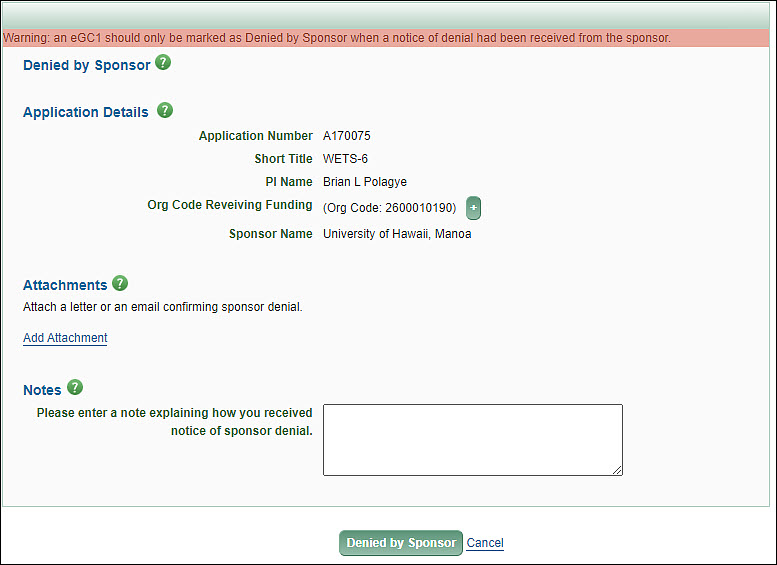
Note: You should only make this status change if the sponsor has notified you. Once you change the eGC1 to Denied By Sponsor status, it will become read-only. You will be able to copy it, but not edit it. Once done, you will not be able to reverse the status change. You will need to contact OSP to have it reset.
Application Details
This section will list a few identifying pieces of information:
- eGC1 Number
- Short Title
- PI Name
- Org Code Receiving Funding
- Sponsor Name
Attachments
This section is used to add an attachment with any documents or email you received confirming the sponsor’s decision.
OSP Notes
This is a required field. Use it to explain why you are making this change of status.
Denied by Sponsor
Click this button to complete the process of changing the eGC1’s status. An entry will be added to the History & Comments page indicating who made the status change, when it was made, and showing the entered notes.
Cancel
Click this link to cancel the status change and return to your eGC1.
New Features
eGC1 Permanently Withdrawn status change by user
SAGE users can now permanently withdraw eGC1s that are in “Withdrawn” or “Returned” status. Previously, only OSP could mark eGC1s as “Permanently Withdrawn”. This will provide SAGE users with a way of quickly removing eGC1s from their tasklist that are no longer being considered for submission to a sponsor.
eGC1 Denied by Sponsor status change by user
SAGE users can now mark “Approved” eGC1s as “Denied by Sponsor” and attach related documentation. Previously, only OSP could set eGC1s as “Denied by Sponsor”. This will provide SAGE users with a quick way of clearing eGC1s from their tasklists that are no longer being considered by sponsors, and improve the accuracy of proposal data.
Continue reading »
A new hire must have a UW NetID and UW email account before you can add them to an eGC1. UW departments/divisions may obtain sponsored UW NetIDs for people who are new to the university and whose academic appointments or positions are not yet active.
If the researcher needs access to SAGE to view or edit eGC1s, then you will also need to authorize them with the appropriate role(s) in ASTRA. If the new person will be the PI, they will need the PI role.
Once the NetID is created, you’ll need to use the NetID look up, as a sponsored person is considered a “non-UW person” until their academic appointment or position is active. Once active, you can go back to any eGC1s where they are listed as non-UW and refresh the information.